Quantum Computing IPO Wave 2026
TECH

Quantum Computing IPO Wave 2026

34+
Signals

Strategic Overview

  • 01.
    Multiple quantum computing companies are going public in early 2026 via SPAC mergers, including Xanadu ($3.1B enterprise value), IQM ($1.8B valuation), and Horizon Quantum (~$1B), while Quantinuum has filed a confidential S-1 targeting a ~$20B valuation IPO.
  • 02.
    Six pure-play quantum computing companies now trade on US exchanges, with Infleqtion becoming the latest to list on February 17, 2026, though its stock fell over 30% on debut.
  • 03.
    BlackRock has emerged as a major institutional backer of quantum computing, investing EUR 50 million in IQM ahead of its SPAC listing, co-leading PsiQuantum's $1B Series E at $7B valuation alongside Temasek and Baillie Gifford.
  • 04.
    High SPAC redemption rates and post-listing sell-offs signal investor caution, with Xanadu experiencing 88.1% shareholder redemptions and multiple new listings falling sharply after debut.

Deep Analysis

Why This Matters

The quantum computing industry is undergoing a pivotal transition from laboratory curiosity to public market commodity. In Q1 2026 alone, three quantum companies completed SPAC mergers to go public, while Quantinuum's confidential S-1 filing at a ~$20B valuation signals that the sector's largest players see public markets as the next logical step. This wave of listings is fundamentally reshaping how quantum computing companies fund their capital-intensive research and development.

The significance extends beyond the quantum sector itself. When the world's largest asset manager, BlackRock, invests EUR 50M in IQM and co-leads PsiQuantum's $1B Series E at $7B valuation, it sends a powerful signal to the broader investment community. The involvement of strategic investors like JPMorgan, Mitsui, NVIDIA, and Amgen as Quantinuum backers further validates the thesis that quantum computing is moving from speculative science project to investable technology category. For the companies themselves, public listings provide access to deeper capital pools needed to sustain the years of R&D still required before fault-tolerant quantum computing becomes a commercial reality.
How It Works

All three major quantum listings in Q1 2026 used Special Purpose Acquisition Companies (SPACs) rather than traditional IPOs. In a SPAC merger, a blank-check company raises funds through its own IPO, then merges with a private target company to take it public. This route allows pre-revenue or early-revenue companies like quantum computing firms to present forward-looking financial projections to investors, something traditional IPO regulations restrict. The SPAC structure has proven particularly attractive to quantum companies because most are still years away from generating meaningful revenue.

The companies going public span different quantum computing approaches. Xanadu uses photonic qubits (particles of light), IQM builds superconducting quantum processors, Quantinuum employs trapped-ion technology with its 630+ employees, and Infleqtion works with neutral atoms. Each approach has distinct advantages and engineering challenges, and as independent analyst The Tech Investor noted, 'none of these approaches has yet demonstrated the fault-tolerant quantum advantage that would make quantum computing genuinely transformative.' By going public, these companies are asking public market investors to place bets on which quantum modality will ultimately achieve commercially viable quantum advantage.

By The Numbers

By The Numbers
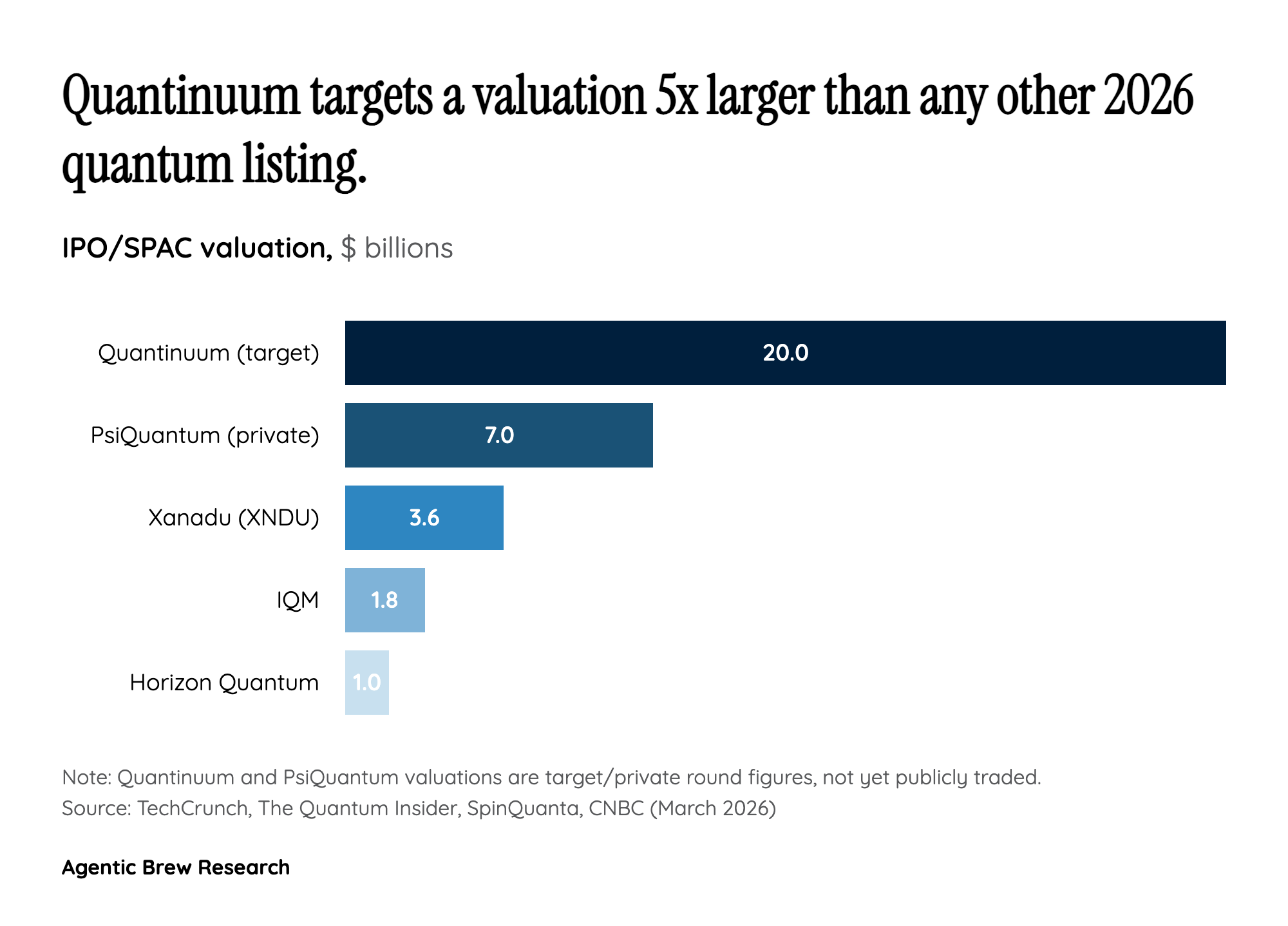
Quantum computing company valuations in the 2026 IPO wave

The scale of quantum valuations in 2026 is striking. Quantinuum's targeted ~$20B IPO valuation would make it the most valuable pure-play quantum company by a wide margin. Xanadu's $3.1B enterprise value and IQM's $1.8B SPAC valuation represent substantial premiums for companies with limited current revenue. IQM reported $35M in 2025 revenue with $100M+ in bookings visibility, while global quantum computing revenues are projected to have exceeded $1B in 2025, up from $650M-$750M in 2024, with forecasts pointing to $10B by 2030.

However, the numbers also reveal significant investor skepticism beneath the headline valuations. Xanadu's SPAC experienced an 88.1% shareholder redemption rate, leaving just $302M in gross proceeds. Post-listing performance has been rough: Infleqtion dropped over 30% on debut, Horizon fell approximately 18% since its listing, and Xanadu declined over 10% in after-hours trading despite closing its first day higher. On X.com, @stocksharks_ highlighted the valuation disconnect, noting quantum stocks were trading at 800x+ sales with zero profitability (363 total engagement). Meanwhile, @commonsenseplay's post calling the sector a speculative bubble drew 5,266 engagements including 4,100 replies, indicating heated retail investor debate. Government funding remains a critical backstop: Xanadu secured up to C$390M from the Canadian government and up to $15M from DARPA, providing non-dilutive capital alongside public market proceeds.

Impacts & What's Next

The immediate impact of this IPO wave is a significant expansion of public market access to quantum computing investment. Europe gained its first publicly traded quantum company through IQM's listing, and the geographic diversity of the new listings — Finland, Canada, Singapore — reflects the global nature of the quantum race. IonQ's milestone of exceeding $100M in annual GAAP revenue provides a critical proof point that quantum companies can generate real commercial revenue.

The coming months will be critical for the sector. Quantinuum's anticipated IPO at ~$20B would be a landmark test of institutional investor appetite for quantum at scale. The high redemption rates and post-listing declines suggest that while there is enthusiasm for quantum's long-term potential, public market investors are demanding more evidence of commercial traction before committing capital. As Horizon CEO Joe Fitzsimons stated, 'the industry is really starting to hit something of an inflection point,' but whether that inflection translates to sustainable public company business models remains to be seen.

The Bigger Picture

This quantum IPO wave echoes the 2021 SPAC boom that first brought quantum computing to public markets, but with important differences. The 2021 cohort went public with less commercial traction. The 2026 class arrives with more mature technology, larger teams, and in some cases actual revenue, but also at significantly higher valuations. The fundamental question remains: can these companies bridge the gap between quantum promise and quantum profitability before they burn through their capital?

Social media discourse on X.com captures this tension in real time. @YahooFinance's announcement of Xanadu's Nasdaq listing as XNDU drew 13,059 engagements, reflecting strong mainstream investor awareness. Yet the most engaged-with commentary is skeptical: @commonsenseplay's post about a speculative bubble generated 5,266 engagements with an unusually high 4,100 replies, suggesting heated debate. Notably, searches on YouTube and Reddit yielded zero relevant results, indicating that the quantum IPO conversation remains largely confined to financial circles on X.com. The presence of sophisticated institutional investors like BlackRock suggests some of the smartest money in the world believes the bet is worth taking. But the 88.1% SPAC redemption rates, steep first-day drops, and concentrated social skepticism show that the market is far from unanimous. Xanadu CEO Christian Weedbrook sees going public as 'a defining moment' opening access to a broader investor base — but it is public market investors, not private backers, who will ultimately determine whether the 2026 quantum IPO wave was prescient or premature.

Historical Context

2021
The first wave of quantum computing SPACs brought IonQ, D-Wave, and Rigetti to public markets, establishing a precedent for pre-revenue quantum companies accessing public capital.
2021
Quantinuum was formed from the merger of Honeywell Quantum Solutions and Cambridge Quantum, creating a full-stack trapped-ion quantum computing company.
September 2025
PsiQuantum raised a $1B Series E at $7B valuation led by BlackRock, Temasek, and Baillie Gifford, signaling major institutional appetite for quantum computing.
September 2025
Quantinuum raised $600M at a $10B pre-money valuation, setting the stage for its later confidential S-1 filing targeting a doubled valuation of ~$20B.
January 14, 2026
Quantinuum filed a confidential S-1 with the SEC, targeting approximately $20B valuation and aiming to raise roughly $1B in what would be the quantum sector's largest IPO.
February 2026
Infleqtion listed on NYSE via SPAC on February 17 (stock fell 30%+ on debut), followed by IQM announcing its SPAC merger at $1.8B valuation on February 23 with BlackRock backing.
March 27, 2026
Xanadu began trading on Nasdaq and TSX as XNDU via SPAC merger with Crane Harbor Acquisition Corp at $3.1B enterprise value, becoming the first pure-play photonic quantum computing company to go public.

Power Map

Key Players
Subject

Quantum Computing IPO Wave 2026

QU

Quantinuum

Honeywell subsidiary and trapped-ion quantum computing leader that filed a confidential S-1 targeting a ~$20B valuation IPO, potentially the largest quantum public offering to date. Backed by JPMorgan, Mitsui, NVIDIA, and Amgen with 630+ employees.

XA

Xanadu Quantum Technologies

Toronto-based photonic quantum computing company that became the first pure-play photonic firm to go public, trading on Nasdaq and TSX as XNDU at $3.1B enterprise value via SPAC merger with Crane Harbor Acquisition Corp.

IQ

IQM Quantum Computers

Finnish superconducting quantum computing company pursuing a SPAC merger at $1.8B valuation, set to become the first publicly traded European quantum company. Reported $35M in 2025 revenue with $100M+ in bookings visibility.

BL

BlackRock

World's largest asset manager making significant bets on quantum computing, investing EUR 50M in IQM and co-leading PsiQuantum's $1B Series E at $7B valuation, lending institutional credibility to the sector.

HO

Horizon Quantum Computing

Singapore-based quantum software company that merged with dMY Squared at approximately $1B valuation, closing in Q1 2026.

IO

IonQ

Pioneer publicly traded quantum company that became the first to exceed $100M in annual GAAP revenue, serving as a benchmark for the sector's commercial viability.

THE SIGNAL.

Analysts

"Going public on Nasdaq and the TSX marks a defining moment for Xanadu as we open the door to a broader global investor base."

Christian Weedbrook
CEO, Xanadu

"The industry is really starting to hit something of an inflection point."

Joe Fitzsimons
CEO, Horizon Quantum Computing

"This financing further strengthens our capital structure, increasing the resources available to enable us to execute on our technology vision and expand into new markets."

Jan Goetz
CEO, IQM Quantum Computers

"None of these approaches has yet demonstrated the fault-tolerant quantum advantage that would make quantum computing genuinely transformative."

The Tech Investor
Independent analyst
The Crowd

"These are the headquarters of the 4 quantum computing companies driving this insane speculative bubble. $IONQ; MC: $23.5Billion $RGTI: MC: $13 Billion $QBTS: MC: $11 Billion $QUBT: MC: $4.5Billion. They are glorified research projects..."

@@commonsenseplay418

"Is quantum computing real or just hype? Quantinuum's $20B IPO will answer that. Quantum stocks up 550% in 2025 Trading at 800x+ sales Zero profitability. This is the test case for the entire sector"

@@stocksharks_363

"Toronto-based quantum computing company Xanadu has started trading on the Nasdaq under the ticker $XNDU. CEO @_cweedbrook on the decision to go public via SPAC"

@@YahooFinance18
Broadcast