NVIDIA Nemotron 3 Nano Omni multimodal model launch
TECH

NVIDIA Nemotron 3 Nano Omni multimodal model launch

40+
Signals

Strategic Overview

  • 01.
    NVIDIA launched Nemotron 3 Nano Omni on April 28, 2026 as an open omni-modal model unifying vision, audio, and language for real-world document analysis, multi-image reasoning, speech recognition, long audio-video understanding, and computer-use agents.
  • 02.
    The model is a 30B-A3B hybrid Mixture-of-Experts (30 billion total parameters, 3 billion active) that interleaves 23 Mamba state-space layers, 23 MoE layers with 128 experts and top-6 routing, and 6 grouped-query attention layers, paired with a C-RADIOv4-H vision encoder and Parakeet-TDT-0.6B-v2 audio encoder.
  • 03.
    NVIDIA claims up to 9x higher throughput than comparable open omni models at the same interactivity, a 131K token context (256K extended in the technical blog), and tops six leaderboards spanning document, video, and audio understanding.
  • 04.
    The model went live day-zero across 25+ partner platforms including Hugging Face, OpenRouter, build.nvidia.com (NIM), Amazon SageMaker JumpStart (FP8), Vultr, Crusoe, and Fal, and is deployable on NVIDIA Jetson, DGX Spark, and DGX Station.

From Selling Shovels to Selling the Whole Stack

For most of the generative-AI cycle, NVIDIA's pitch has been simple: every model gets trained and served on our chips, so we win regardless of who builds the AGI. Nemotron 3 Nano Omni is the clearest signal yet that the company no longer believes that posture is sufficient. By shipping an open-weight 30B-A3B multimodal model with a stated goal of powering enterprise computer-use agents, document intelligence, and factory-floor inspection, NVIDIA is moving from infrastructure provider to model provider — competing, however gently, with the very labs that buy its GPUs.

The strategic logic shows up clearly in the launch's named partners. Foxconn for manufacturing, Palantir for government and operations, H Company for computer-use agents, Eka Care for healthcare in India — these are exactly the kinds of customers who buy enterprise platforms, not single API tokens. Futurum Group's David Nicholson reads the move as a hedge against hyperscaler pressure on NVIDIA's hardware margins, suggesting the company is positioning open Nemotron weights as a way to keep enterprises building on NVIDIA's stack end-to-end even as Amazon, Google, and Microsoft push their own silicon. On Reddit, one r/ArtificialIntelligence post framed it bluntly: NVIDIA is 'no longer just selling the shovels.' Whether that becomes a durable second franchise or just a defensive moat is the open question Nicholson himself raises — is this a hyperscaler play, an SMB play, or both?
The Duct Tape That Just Got Removed

The single technical idea worth understanding here is what NVIDIA is replacing, not what it built. Until now, almost every production 'multimodal' agent has been a Frankenstein: a vision model for screenshots, a separate ASR model for audio, a third LLM to reason over the outputs, a glue layer that serializes everything into text and ships it across an API. AI analyst Cobus Greyling puts it sharply — 'Most multimodal AI systems aren't multimodal. They're a stack of single-modal models duct-taped together behind an API.' Each handoff loses cross-modal context, doubles latency, and creates failure modes that are nearly impossible to debug.

Nano Omni's architectural answer is to fuse a C-RADIOv4-H vision encoder and a Parakeet-TDT-0.6B-v2 audio encoder directly into a Nemotron 3 hybrid Mamba-Transformer MoE backbone. The model interleaves 23 Mamba state-space layers (cheap long-context handling), 23 MoE layers with 128 experts and top-6 routing (capacity), and 6 grouped-query attention layers (global mixing). For video, it uses a Conv3D 'tubelet' embedding that fuses pairs of consecutive frames before they reach the ViT, halving vision tokens. The cumulative effect is what H Company's Gautier Cloix highlights: agents can interpret full HD screen recordings in real time — a workload his team simply could not run before. That's a concrete capability shift, not a benchmark talking point. If you've been gluing together Whisper + a VLM + a text LLM behind your agent, this is the first credible 'just use one model' option at this scale.

The 9x Asterisk

The 9x Asterisk
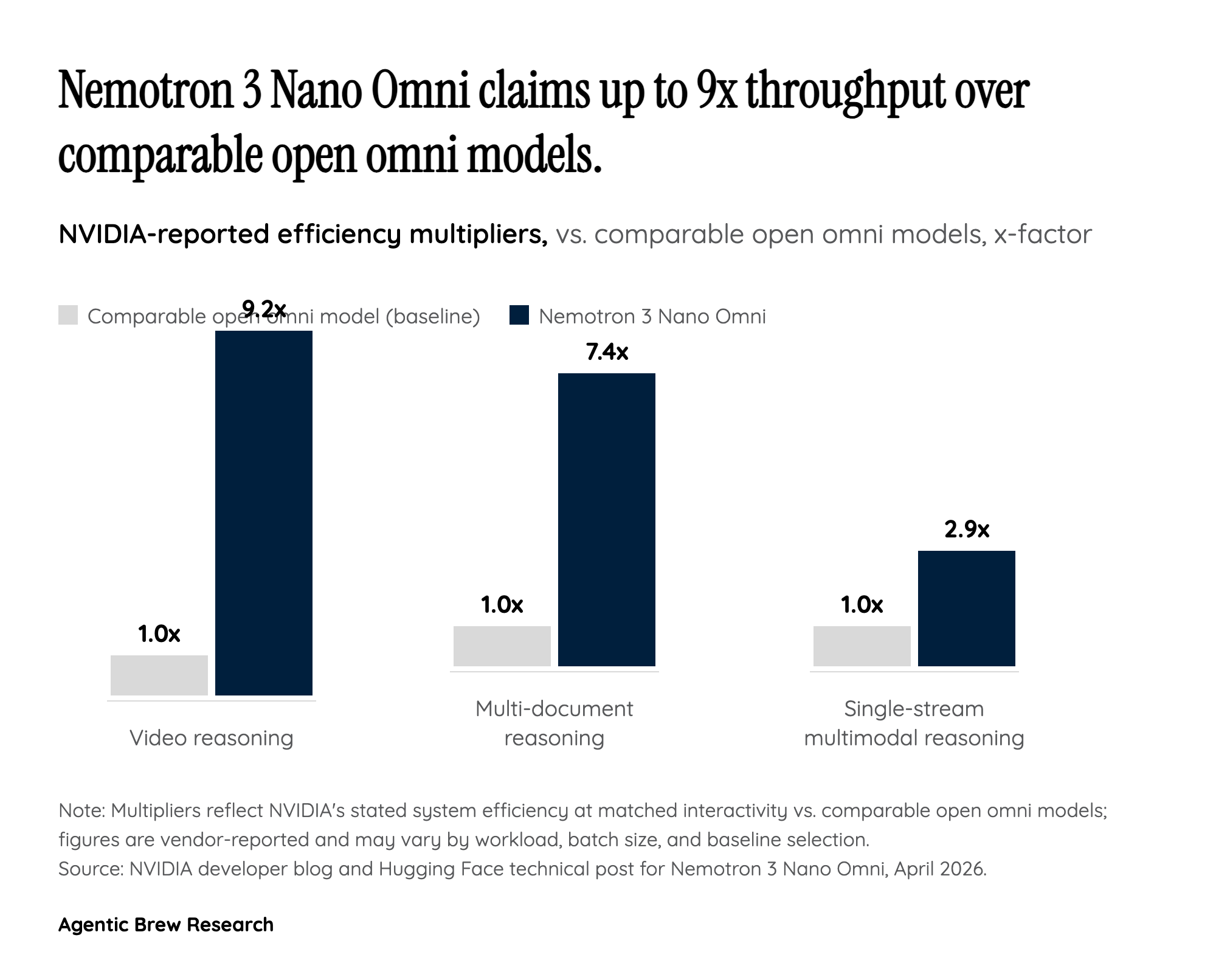
NVIDIA's claimed efficiency multipliers for Nemotron 3 Nano Omni vs. comparable open omni models, by workload.

The headline number on every launch slide is '9x higher throughput than comparable open omni models,' supplemented by 7.4x for multi-document reasoning and 9.2x for video reasoning. These are not invented figures — they appear in NVIDIA's developer blog, the Hugging Face technical post, and AWS's SageMaker JumpStart announcement. But the multiplier deserves scrutiny, because the comparison set is doing most of the work.

A skeptical voice in r/LocalLLaMA pushed on this directly, arguing the 9x throughput claim 'is almost certainly versus dense 7B-13B baselines at similar quality, not raw 30B-dense, because sparse activation cuts FLOPs but not KV cache or attention bandwidth.' The point is technically important: a 30B-A3B MoE only fires 3B parameters per forward pass, so its FLOP budget per token is small — but it still has to materialize and attend over the same KV cache as a 30B-dense model would. That makes throughput numbers extremely sensitive to batch size, sequence length, and what you're calling a 'comparable' baseline. Cobus Greyling's framing — '30B knowledge at 3B inference cost' — captures the upside honestly, but it's a FLOP statement, not a memory-bandwidth statement. The practical takeaway for builders: the speedup is real on the workloads NVIDIA optimized for (long-context multimodal reasoning where MoE sparsity dominates), and probably more modest on shorter prompts where attention isn't the bottleneck. The 9x is not a lie; it's a benchmark, and like every benchmark it has a shape.

Stuck Between 24 and 32 Gigabytes

If NVIDIA's marketing target is the enterprise, its loudest early audience is the local-LLM crowd — and that audience has a complaint. Day-zero GGUF quants from Unsloth land at roughly 25GB for 4-bit and 36GB for 8-bit. Those numbers fall in exactly the wrong gap: 4-bit just exceeds the 24GB ceiling on the 4090 and 7900XTX, and 8-bit just exceeds the 32GB on the new 5090. One r/unsloth commenter captured the mood — 'just like nvidia to publish a model that is just out of reach.' The model can be run, but only by stacking GPUs (one impressed user reported a 5090+3090 rig hitting 267k context) or by stepping down to a more aggressive quant that the community is still evaluating. For a launch positioned as 'open' and 'on-device down to Jetson and DGX Spark,' the consumer-card story is awkwardly bracketed between two SKUs.

The reception has a second seam: capability mix. Hands-on YouTube reviewers — including one who put it through a full benchmark suite of browser-OS interaction, vibe coding, long-context, and roleplay tasks — generally praised raw intelligence and the reasoning toggle, with the multimodal variant earning specific positive notes. But several r/LocalLLaMA comments were blunt that this is not a coding model, with one user saying Qwen3-Next 'runs circles around nemotron for any and all coding tasks.' That fits the design goal: NVIDIA optimized Nano Omni for perception-heavy agent workloads — document intelligence, screen understanding, audio-video reasoning — not for IDE autocomplete. Reading the social signal correctly means accepting that this is a perception engine first and a generalist coder somewhere further down. Builders picking it up should match it to the job, and budget VRAM accordingly.

Historical Context

2023-11
Introduced Nemotron-3 8B for enterprise chatbot and copilot development on the NeMo framework — the first publicly branded Nemotron release.
2024-06
Released the Nemotron-4 340B family (Base, Instruct, Reward) aimed at synthetic data generation and instruction tuning.
2024-10
Released Llama-3.1-Nemotron-70B-Instruct, a Llama 3.1 derivative tuned with NVIDIA's reward model.
2025-01
At CES, announced the Llama Nemotron family in Nano, Super, and Ultra tiers for enterprise applications.
2025-08
Published the Nemotron Nano 2 technical report, introducing a hybrid Mamba-Transformer recipe focused on efficient inference — the architectural ancestor of Nano Omni.
2025-12
Announced the Nemotron 3 family and shipped Nemotron 3 Nano at launch, with Super and Ultra slated for 2026.
2026-04-28
Launched Nemotron 3 Nano Omni — the multimodal extension of Nemotron 3 Nano — across Hugging Face, OpenRouter, AWS SageMaker JumpStart, Vultr, Crusoe, and Fal, with named adopters including H Company, Foxconn, Palantir, and Eka Care.

Power Map

Key Players
Subject

NVIDIA Nemotron 3 Nano Omni multimodal model launch

NV

NVIDIA

Model developer extending its franchise from GPUs into open-weight multimodal foundation models for enterprise agentic AI; the launch is its most explicit move into the model layer.

H

H Company

Early adopter using Nemotron 3 Nano Omni to power computer-use agents that interpret full HD (1920x1080) screen recordings in real time, a workload its CEO says was infeasible before.

FO

Foxconn

Manufacturing adopter deploying Nano Omni for factory-floor visual inspection and shop-floor AI agents — a marquee industrial reference for the model.

PA

Palantir

Enterprise software adopter integrating Nano Omni into document and operational intelligence workflows, lending the launch credibility with government and large-enterprise customers.

AM

Amazon Web Services (SageMaker JumpStart)

Cloud distribution partner offering Nano Omni in FP8 precision day-zero, giving the model immediate reach to AWS's enterprise base.

VU

Vultr

Independent cloud partner deploying Nano Omni on dedicated NVIDIA GPU clusters and via serverless inference accelerated by NVIDIA Dynamo 1.0 — important for builders who want non-hyperscaler options.

Source Articles

Top 5

THE SIGNAL.

Analysts

"Says Nano Omni unlocks practical real-time HD screen-recording interpretation for computer-use agents: 'By building on Nemotron 3 Nano Omni, our agents can rapidly interpret full HD screen recordings — something that wasn't practical before.'"

Gautier Cloix
CEO, H Company

"Argues most 'multimodal' systems are really single-modal models duct-taped together behind an API, and that Nano Omni 'makes a credible argument that we can stop doing this — at least for the perception layer of agent systems.' He frames the MoE design as giving 'the knowledge capacity of a 30B model but the inference cost of a 3B model.'"

Cobus Greyling
AI analyst (Substack)

"Reads the open-model push as a strategic response to hyperscaler pressure on NVIDIA's hardware margins, noting 'NVIDIA is thinking that this is going to be a hyperscale cloud provider strategy' while also positioning to make agent-building easier across modalities."

David Nicholson
Analyst, Futurum Group
The Crowd

"Meet Nemotron 3 Nano Omni 👋 Our latest addition to the Nemotron family is the highest efficiency, open multimodal model with leading accuracy. 30B parameters. 256K context length. 🧵👇"

@@NVIDIAAI0

"🚀 NVIDIA Nemotron 3 Nano Omni is now live on SGLang! Built for multimodal agentic AI, Nemotron 3 Nano Omni brings image, audio, video, and text into one reasoning loop, helping developers avoid fragmented stacks of separate perception models."

@@lmsysorg0

"NVIDIA Nemotron 3 Nano Omni is now available on Amazon SageMaker JumpStart. This multimodal model supports video, audio, image, and text, enabling enterprise Q&A, summarization, transcription, OCR, and document intelligence."

@@AWSAI0

"NVIDIA releases Nemotron-3-Nano-Omni"

@u/yoracale194
Broadcast
NVIDIA Nemotron 3 Nano 30B (A3B): This SMALL & OPEN Model is SO GOOD!

NVIDIA Nemotron 3 Nano 30B (A3B): This SMALL & OPEN Model is SO GOOD!

NVIDIA Nemotron 3 Nano First Look & Testing – A VERY Smart Model!

NVIDIA Nemotron 3 Nano First Look & Testing – A VERY Smart Model!

NVIDIA Nemotron 3 Nano 30B First Impression - Shipmas Day 11

NVIDIA Nemotron 3 Nano 30B First Impression - Shipmas Day 11