GPT-Realtime voice control integration
TECH

GPT-Realtime voice control integration

32+
Signals

Strategic Overview

  • 01.
    On May 7, 2026, OpenAI released three new realtime audio models — GPT-Realtime-2 (flagship voice reasoning), GPT-Realtime-Translate (live streaming translation), and GPT-Realtime-Whisper (live transcription) — and moved the Realtime API out of beta into general availability.
  • 02.
    GPT-Realtime-2 brings GPT-5-class reasoning into a speech-to-speech model, supports preambles (short conversational fillers) and parallel tool calls, and expands the context window from 32K to 128K tokens — enough to hold a full customer history within a single voice session.
  • 03.
    The CRM voice-control demo referenced in the topic traces back to gpt-realtime-1.5, released April 2026, where OpenAI Developers spotlighted a hands-on integration by Charlie Guo (@charlierguo) showing reliable instruction following, tool calling, and multilingual accuracy.
  • 04.
    Developers can dial reasoning intensity across five levels (minimal, low, medium, high, xhigh), trading latency for depth on a per-session basis — meaning the same model can power both snappy app commands and deeper agentic workflows.

Why 128K Tokens Is the CRM Unlock

The headline benchmark numbers got the press, but the change that actually makes voice control over a CRM viable is quieter: the context window quadrupled from 32K to 128K tokens. TheNextWeb reports that this makes 'longer sessions and complex agentic flows feasible without external state stitching.' For a CRM workflow, that distinction matters. A 32K window forced developers to summarize, evict, or RAG the customer record on every turn — which works for a five-minute call but breaks for a salesperson who wants to update notes, schedule a follow-up, and reference last quarter's renewal in the same conversation. With 128K, the full customer history lives inside the session, and the model can reason against it natively. This is what Charlie Guo's demo, originally built on gpt-realtime-1.5 and amplified by Kwindla Hultman Kramer of Pipecat as 'perfect performance on a hard end-to-end' task, hints at: voice agents can now hold state, not just respond. Combine that with the move from a flat speech-to-speech model to one with GPT-5-class reasoning, and the architectural pattern changes — instead of a thin voice layer wrapped around a separate orchestrator, the Realtime model itself becomes the orchestrator.
Preambles, Parallel Tools, and the End of Dead Air

Anyone who has built a voice agent knows the failure mode: the user finishes their sentence, the model goes silent while it reasons and calls a tool, and three seconds of dead air later the illusion is broken. GPT-Realtime-2's two understated features attack exactly this. Preambles let the model emit short conversational fillers — 'let me check that for you' — while reasoning runs in the background, per The Neuron Daily. Parallel tool calls let the same agent fire a CRM lookup and a calendar query simultaneously instead of serializing them. The combination is what Latent Space had in mind when it called this 'the first OpenAI speech-to-speech model good enough for voice agents that do real work.' Romain Huet at OpenAI underscored the same point demoing @jxnlco's app: 'The model is listening, deciding when to call functions to update state, and yes, it doesn't always have to talk back!' That last clause is the real shift — voice agents are no longer forced to narrate every turn. They can listen, act on app state silently, and only speak when speaking adds value.

By The Numbers: The Benchmark-vs-Production Gap

By The Numbers: The Benchmark-vs-Production Gap
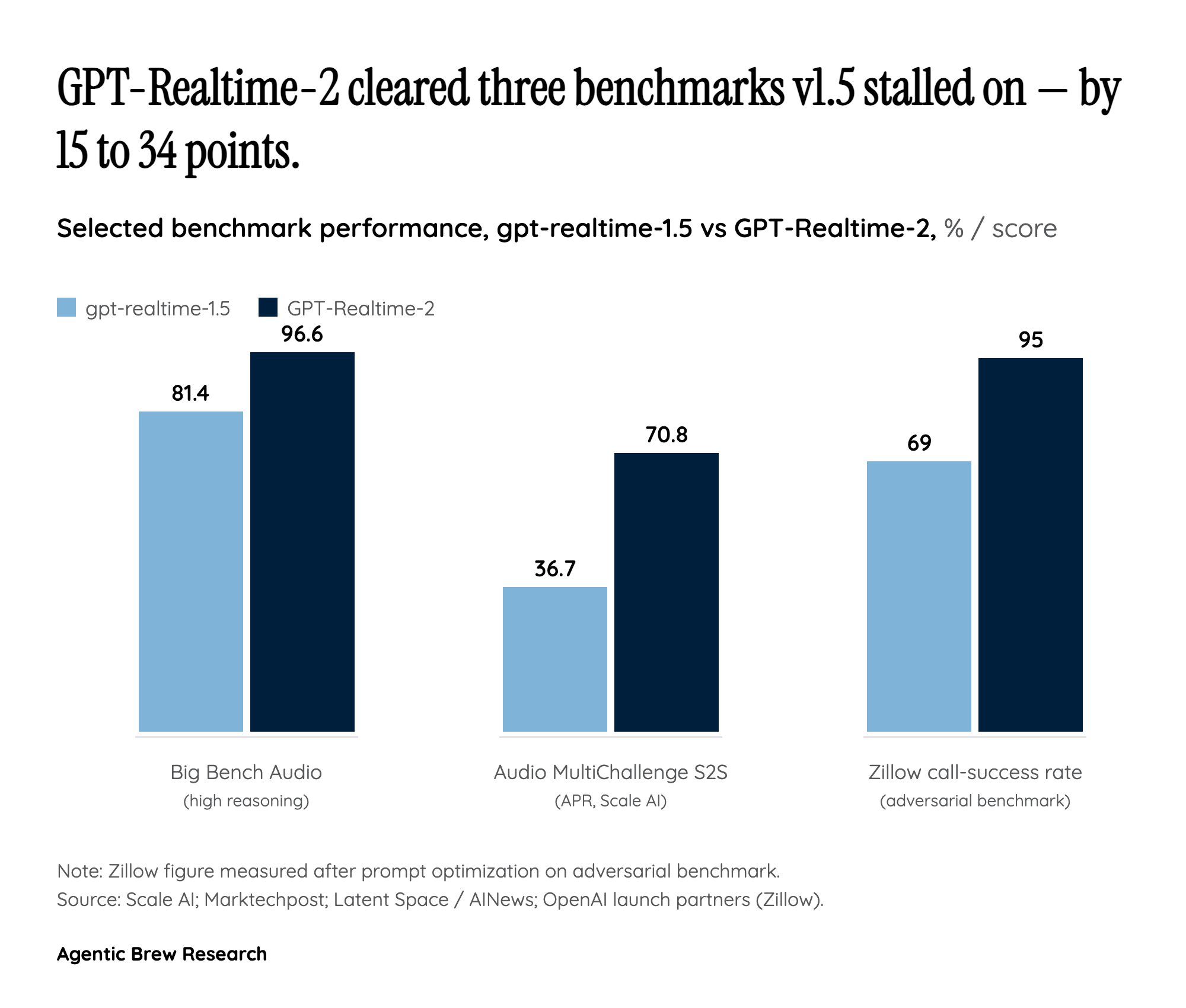
GPT-Realtime-2 delivers 15-34 point jumps on the benchmarks that gate voice CRM workflows.

The marketing numbers are real but come with footnotes. GPT-Realtime-2 hits 96.6% on Big Bench Audio versus 81.4% for v1.5, and Audio MultiChallenge S2S instruction retention jumped from 36.7% to 70.8% per Scale AI. But Latent Space flags that these headline scores were run at high or xhigh reasoning, while production voice apps will almost certainly default to 'low' to keep latency tolerable — time-to-first-audio is 2.33s at high reasoning versus 1.12s at minimal. End-user quality may not match the benchmark page. There's a parallel quality story on the voice side: an OpenAI Developer Community thread titled 'gpt-realtime-1.5: major regression in voice expressiveness and accent quality' describes a tradeoff between the smarter reasoning and how the voice actually sounds. Reddit's r/accelerate echoed it bluntly — 'smarter than 4o voice but more robotic.' And the economics are non-trivial: $32 per million audio-input tokens, $64 per million audio-output, $0.034/min for Translate, $0.017/min for Whisper. Practitioners on r/aicuriosity report cutting prompts from 30k down to 2-3k tokens via multi-agent triage with session.update, saving roughly $0.01 per minute — a reminder that always-on CRM voice control gets expensive fast without prompt discipline.

Historical Context

2024-10-01
Realtime API launched in public beta, enabling low-latency bidirectional audio streaming.
2025-08-28
Original gpt-realtime model and Realtime API hit general availability, adding remote MCP servers, image inputs, SIP phone calling, and two new voices (Cedar, Marin).
2026-04-01
Released gpt-realtime-1.5 with improved instruction following, tool calling, and multilingual accuracy: +5% on Big Bench Audio, +10.23% on alphanumeric transcription, +7% on instruction following vs. predecessor. The Charlie Guo CRM-style voice demo lands the same day.
2026-05-07
Launched GPT-Realtime-2, GPT-Realtime-Translate, and GPT-Realtime-Whisper; Realtime API moves from beta to GA with parallel tool calls, preambles, and a 128K context window.

Power Map

Key Players
Subject

GPT-Realtime voice control integration

OP

OpenAI

Model provider; ships GPT-Realtime-1.5 / 2 / Translate / Whisper and the Realtime API; sets pricing and benchmarks that anchor the voice-agent ecosystem.

CH

Charlie Guo (@charlierguo)

Developer who built the showcased gpt-realtime-1.5 voice demo highlighted by OpenAI Developers — the concrete CRM/app voice-control use case referenced in the topic.

ZI

Zillow

Enterprise launch partner using GPT-Realtime-2 for home-search voice agents; reports a 26-point lift in call-success rate (69% to 95%) on an adversarial benchmark after prompt optimization.

DE

Deutsche Telekom

Testing live-translated voice support across 14 European markets using GPT-Realtime-Translate.

GL

Glean, Genspark, Vimeo, BolnaAI, Intercom, Priceline, Foundation Health, Bluejay

Production customers building voice agents on the Realtime API across knowledge work, call automation, and translation; Glean reports a 42.9% relative helpfulness lift, Genspark a 26% lift in effective conversation rate.

SE

Sendbird

Chat/messaging API vendor that publicly praised gpt-realtime-1.5's interruption handling — a key UX gate for voice control over apps.

Source Articles

Top 3

THE SIGNAL.

Analysts

"Calls gpt-realtime-1.5 a major jump in tool calling and instruction following on voice-agent benchmarks, and cites Charlie Guo's demo as a clean end-to-end example of the model performing on a hard task."

Kwindla Hultman Kramer
Co-founder, Daily / Pipecat (voice agent framework)

"Positions gpt-realtime-1.5 as strengthening voice workflows via instruction following, tool calling, and multilingual accuracy — the three capabilities required for voice control over app state."

OpenAI Developers (official)
OpenAI developer relations

"Frames voice as the last surface where knowledge workers haven't felt AI inside their workday, positioning GPT-Realtime-2 as the unlock for embedded voice control over apps and CRMs."

The Neuron Daily
AI industry newsletter

"Characterizes GPT-Realtime-2 as the first OpenAI speech-to-speech model good enough for voice agents doing 'real work' — i.e., tool-calling against business systems rather than acting as a chat toy."

Latent Space / AINews
AI developer newsletter
The Crowd

"Voice workflows just got stronger with gpt-realtime-1.5 in the Realtime API. The model offers more reliable instruction following, tool calling, and multilingual accuracy. Demo with @charlierguo"

@@OpenAIDevs0

"The Realtime API is fast. This demo by @jxnlco is running at real speed! No computer use, just realtime speech + function calling. The model is listening, deciding when to call functions to update state, and yes, it doesn't always have to talk back!"

@@romainhuet0

"Introducing GPT-Realtime-2 in the API: our most intelligent voice model yet, bringing GPT-5-class reasoning to voice agents. Voice agents are now real-time collaborators that can listen, reason, and solve complex problems as conversations unfold. Now available in the API"

@@OpenAI0

"New OpenAI Voice models: GPT-Realtime-2, Translate, and Whisper"

@u/Rollertoaster7226
Broadcast
Introducing gpt-realtime in the API

Introducing gpt-realtime in the API

We're introducing three audio models in the API

We're introducing three audio models in the API

5 New Features in the GPT Realtime API (GA Release) for Advanced Voice Agents

5 New Features in the GPT Realtime API (GA Release) for Advanced Voice Agents