US B CHIPS Act Quantum Funding
TECH

US B CHIPS Act Quantum Funding

33+
Signals

Strategic Overview

  • 01.
    The U.S. Department of Commerce signed letters of intent on May 21, 2026 to deliver $2.013 billion in CHIPS and Science Act funding to nine quantum companies — two foundries (IBM, GlobalFoundries) and seven quantum computing firms (Atom Computing, Diraq, D-Wave, Infleqtion, PsiQuantum, Quantinuum, Rigetti).
  • 02.
    Every dollar is conditional on Commerce receiving a minority, non-controlling equity stake in each recipient — D-Wave alone committed to issue $100M in common stock to the government, and GlobalFoundries disclosed Commerce will hold roughly 1% ownership.
  • 03.
    IBM is the headline recipient at $1B, matched dollar-for-dollar with $1B of its own cash plus IP, assets, and workforce to spin up Anderon, a 300-millimeter quantum wafer foundry in Albany, NY — the first purpose-built quantum foundry in the United States.
  • 04.
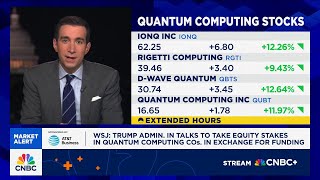
    Markets responded immediately: D-Wave jumped roughly 19%, Rigetti 15%, IonQ 9%, IBM 6%, and GlobalFoundries 9.2% — with notable absences (most prominently IonQ) sparking debate over which qubit modalities Washington chose to back.

Deep Analysis

The Mechanism Shift: Grants Are Out, Equity Is In

The headline number is $2.013 billion [1], but the real story is in the fine print: every dollar is conditional on the U.S. Department of Commerce receiving a minority, non-controlling equity stake in the recipient company [1]. This is not how CHIPS Act money was originally supposed to work. The 2022 statute was drafted around grants and tax credits; the equity overlay is a 2025-2026 invention, road-tested first on Intel — where the federal government negotiated close to a 10% stake — and then on rare-earths suppliers [4]. The quantum LOIs are the first time the model has been applied across an entire technology sector in a single announcement.

The most concrete glimpse of what this looks like in practice comes from D-Wave, which disclosed it will issue $100 million of its common stock to Commerce upon execution of final award documents [5]. GlobalFoundries went further and quantified the dilution: Commerce will hold roughly 1% of the company as of the deal's effective date, with CEO Tim Breen framing it as a way for the American public to share in GF's growth [6]. Secretary Howard Lutnick echoed that framing at the federal level, calling the equity structure a mechanism to enhance the return for the U.S. taxpayer [1]. Whether you read that as smart industrial policy or as the federal government quietly nationalizing a slice of the quantum sector, the precedent is now durable — and the next administration will inherit a balance sheet, not just a grant program.

By The Numbers: A $2B Bet, Lopsided By Design

By The Numbers: A $2B Bet, Lopsided By Design
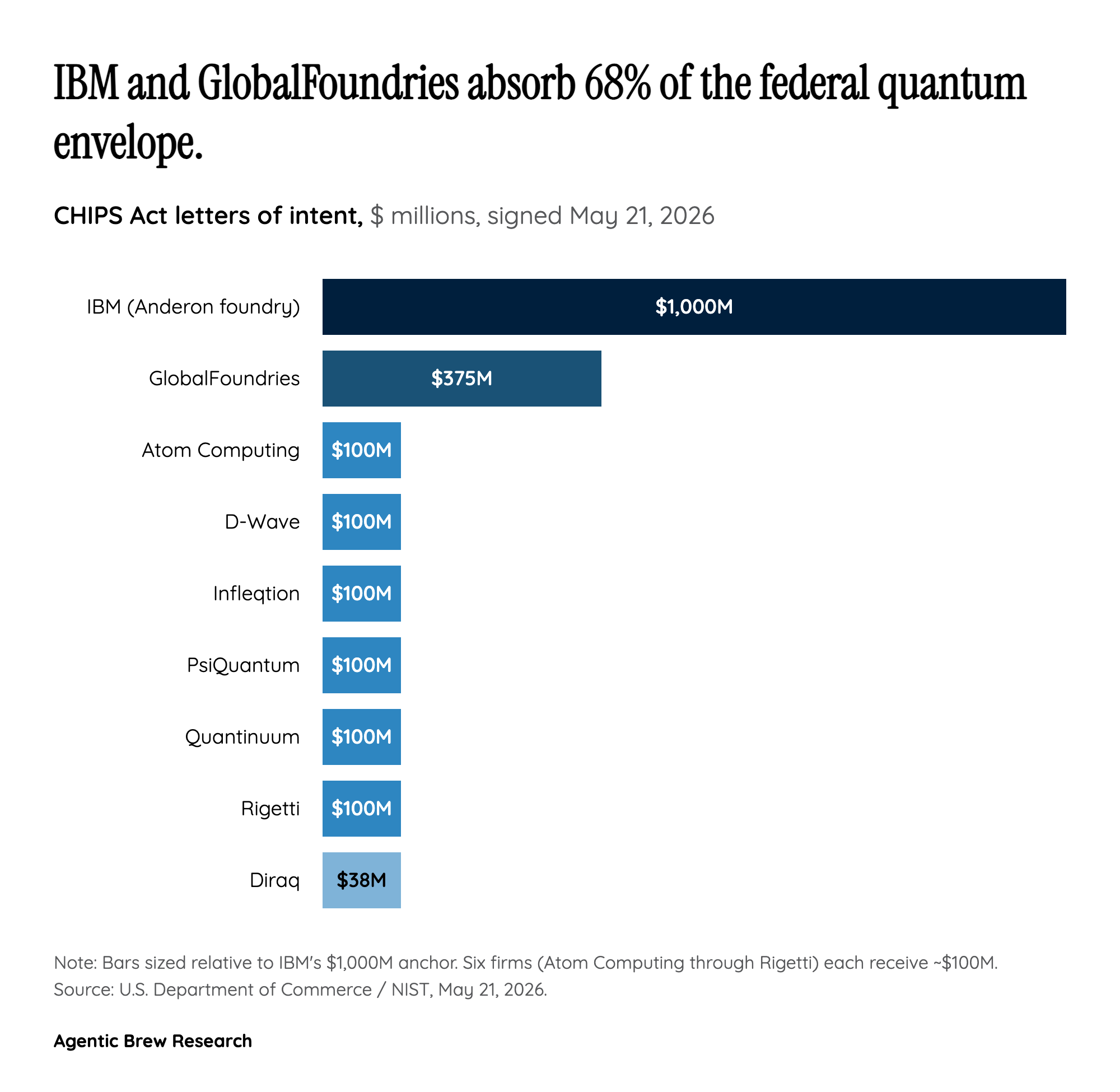
Distribution of $2.013B in CHIPS Act letters of intent across nine quantum recipients, May 21, 2026.

The funding split is not a meritocratic ranking — it is a deliberate barbell. IBM receives $1 billion [3], exactly half the entire envelope, and matches it with another $1 billion of its own cash plus IP, assets, and a dedicated workforce to stand up Anderon, the new Albany foundry [3]. GlobalFoundries takes the next $375 million [1]. The remaining $638 million is sliced thin: six companies (Atom Computing, D-Wave, Infleqtion, PsiQuantum, Quantinuum, and Rigetti) each pull roughly $100 million, and Diraq closes the table at up to $38 million [2][9].

Read the shape and the strategy reveals itself. Roughly 68% of the money goes to manufacturing infrastructure (IBM + GlobalFoundries); roughly 32% is spread across seven separate qubit-modality bets [1]. Commerce is paying a heavy premium to guarantee that whichever modality wins the next decade — superconducting, trapped ion, neutral atom, photonic, topological, or silicon spin — the wafer that powers it is fabricated on U.S. soil. The $38M Diraq line item is the cheapest tell: silicon spin is a long-shot modality, but Commerce wanted it in the portfolio anyway.

The Portfolio Hedge: Washington Refuses To Pick A Qubit

The most underappreciated line in the official release comes from Bill Frauenhofer, the Commerce official running the program, who explicitly described the spread as a portfolio approach to strengthen and accelerate U.S. leadership across multiple quantum modalities at once [1]. That single sentence is the entire intellectual scaffold of the deal. Quantum computing today has no equivalent of the CMOS-transistor consensus that powers classical chips. Superconducting qubits (IBM, Rigetti) need millikelvin dilution refrigerators; trapped ions (Quantinuum, IonQ — notably absent) use laser-controlled atoms; neutral atoms (Atom Computing, Infleqtion) use optical tweezers; photonic qubits (PsiQuantum) run at room temperature with light; silicon spin qubits (Diraq) try to ride the existing semiconductor manufacturing curve. Each modality has different yield economics, different scaling ceilings, and different failure modes.

Commerce's answer is to refuse the question. By funding seven hardware companies across five-plus modalities — and then pairing them with a multi-modality foundry at GlobalFoundries explicitly designed to handle superconducting, trapped ion, photonic, topological, and silicon spin wafers [1]— the U.S. effectively buys a basket option on quantum's eventual winner. Industry analysts have framed the urgency in geopolitical terms: governments in China, the EU, India, and Japan are running separate state-backed quantum programs, making domestic modality-diversity a strategic imperative rather than a luxury [8]. The omission of IonQ is the conspicuous gap; even community forums tracking the trapped-ion vendor flipped from disappointment to relief that the company avoided dilution, but the absence sharpens a question Commerce hasn't answered publicly: which modalities did the agency decide were already adequately capitalized?

Anderon And The Missing American Quantum Foundry

Until this announcement, there was no purpose-built quantum foundry in the United States. IBM fabricated its own qubit chips in research facilities; everyone else patched together capacity wherever they could find it. Anderon — the new 300-millimeter Albany shop funded by IBM's $1B CHIPS award plus IBM's own $1B contribution — is engineered to close that gap [3]. Its initial process focus is superconducting qubit wafers and supporting electronics, but the disclosed capability list reads like a list of every previously-missing primitive in U.S. quantum manufacturing: superconducting wiring, through-silicon vias, bumps, dedicated process design kits (PDKs), and in-line wafer testing and characterization [3]. Crucially, IBM has committed that Anderon will serve multiple quantum hardware vendors, not just IBM — meaning the company is using federal money to build infrastructure its direct competitors will also use [3].

That positioning matters because IBM has publicly committed to delivering the world's first large-scale, fault-tolerant quantum computer for commercial clients by 2029 [3]. Fault-tolerance — the ability to run arbitrarily long quantum computations by detecting and correcting errors faster than they accumulate — is the threshold past which quantum stops being a science project and starts being a product. CEO Arvind Krishna's framing of silicon wafer fabrication as the key to reshape global innovation and economic competitiveness [3]is more than a press-release flourish; it's an admission that the 2029 timeline is unachievable without an industrial-scale wafer line. Anderon is the wafer line.

The Timeline Trap: Useful Quantum Is Still A Decade-Plus Out

Every triumphant LOI in this package is shadowed by a sobering timeline. Commerce officials acknowledged, in the same announcements that celebrated the deals, that the investments could take years to pan out [4]. NVIDIA CEO Jensen Huang has been blunter in public, putting truly useful standalone quantum computers approximately 15-20 years away [7]— a horizon that easily outlasts not just the current presidential term but the entire CHIPS Act's funding cycle. Markets nonetheless reacted as if the technology were imminent: D-Wave jumped 19%, Rigetti 15%, IonQ 9%, IBM 6%, GlobalFoundries 9.2% [4][7]. Infleqtion briefly fell 15.8% before recovering, an outlier that suggests the market is still calibrating which modalities it considers genuinely de-risked by the federal validation [7].

There are two political risks embedded in that gap between near-term euphoria and decade-plus payoff. The first is administrative: the LOIs are letters of intent, not signed final award documents — Commerce officials publicly noted years until they pan out [4], leaving the program exposed to a future administration that might revoke, restructure, or politicize the equity stakes the way prior CHIPS commitments have been renegotiated. The second is financial: the equity model only generates the promised taxpayer return if the funded companies actually deliver commercial products inside the political lifespan of the people who structured the deal. If Huang's 15-20-year forecast is even directionally correct [7], the politicians who can claim credit for this $2B bet will likely be retired before the U.S. Treasury ever marks the position to market.

Historical Context

2022-08-09
President Biden signs the CHIPS and Science Act into law, authorizing federal incentives for domestic semiconductor manufacturing and R&D — the same statute that, four years later, funds the quantum LOIs.
2025
The U.S. government negotiates a nearly 10% equity stake in Intel as part of CHIPS-related support — the precedent transaction that establishes equity-for-funding as a viable industrial-policy template.
2025-2026
The administration extends the equity-for-funding model to rare-earths companies, signaling a broader pattern of taking ownership in strategically vital firms that the quantum LOIs now extend to a third sector.
2026-05-21
Commerce signs nine quantum LOIs totaling $2.013B — the largest single U.S. government commitment to quantum manufacturing to date and the first time the equity model is applied across an entire technology sector simultaneously.

Power Map

Key Players
Subject

US B CHIPS Act Quantum Funding

U.

U.S. Department of Commerce

Architect and counterparty of the $2.013B portfolio; takes minority equity in all nine recipients and explicitly frames the spread as a hedge across superconducting, trapped ion, photonic, topological, neutral atom, and silicon spin qubit modalities.

IB

IBM

Largest single recipient ($1B) and only company building a wafer foundry; matches Commerce with $1B in cash plus IP and workforce, and ties Anderon directly to its public commitment to deliver a large-scale fault-tolerant quantum machine for commercial clients by 2029.

GL

GlobalFoundries

Receives $375M to stand up a secure domestic multi-modality quantum foundry; concedes ~1% ownership to Commerce, making it the second pillar of the U.S. quantum manufacturing base alongside Anderon.

D-

D-Wave Quantum

Receives $100M and commits to issuing $100M of common stock to Commerce; uses the funds to back a 100,000-qubit annealing system, a 10,000-qubit gate-model system, and operations in Boca Raton, New Haven, and Burnaby.

DI

Diraq

Australian-rooted silicon spin qubit startup and smallest recipient at up to $38M; its inclusion is the clearest signal that Commerce is deliberately funding modalities far from the superconducting mainstream.

TR

Trump administration / Secretary Howard Lutnick

Frames the LOIs as the next chapter in an emerging industrial-policy playbook that already produced an ~10% federal stake in Intel and equity-for-funding deals with rare-earths suppliers; positions the structure as a taxpayer-return mechanism, not just a subsidy.

Fact Check

9 cited
  1. [1] Department of Commerce Announces Letters of Intent with 9 Companies for $2 Billion to Accelerate U.S. Leadership in Quantum Computing
  2. [2] U.S. Department of Commerce Announces Letters of Intent with 9 Companies for $2 Billion
  3. [3] IBM and U.S. Department of Commerce Announce America's First Purpose-Built Quantum Foundry
  4. [4] U.S. taking equity stakes in 9 quantum computing companies
  5. [5] D-Wave and Department of Commerce Sign Letter of Intent for $100 Million in CHIPS and Science Act Funding
  6. [6] Commerce inks deals worth $2 billion in incentives for nine quantum companies
  7. [7] Quantum Stocks Erupt As US Government Awards $2 Billion And Takes Equity Stakes
  8. [8] U.S. to Invest $2B in Quantum Computing
  9. [9] Diraq Signs $38 Million Letter of Intent Under CHIPS Act to Scale Silicon Spin Technology

Source Articles

Top 5

THE SIGNAL.

Analysts

"Casts the deal as the Trump administration leading the world into a new era of American innovation, with quantum framed as the next strategic frontier after semiconductors."

Howard Lutnick
U.S. Secretary of Commerce

"Defends the spread across nine recipients as a deliberate portfolio strategy meant to accelerate U.S. leadership across multiple quantum modalities at once while focusing each award on a discrete technological problem."

Bill Frauenhofer
Executive Director of Semiconductor Investment and Innovation, U.S. Commerce

"Positions IBM's silicon wafer fabrication expertise as the foundation of a national quantum manufacturing capability and argues Anderon will reshape global economic competitiveness by serving the broader quantum hardware ecosystem, not just IBM."

Arvind Krishna
Chairman and CEO, IBM

"Treats the partnership as part of a coordinated national push for supply-chain resilience, arguing that revolutionary technologies like quantum must be developed and manufactured on U.S. soil."

Tim Breen
CEO, GlobalFoundries

"Provides the contrarian timeline check: argues that truly useful standalone quantum computers remain 15-20 years out, a horizon that frames the entire $2B bet as a long-duration industrial wager rather than a near-term product push."

Jensen Huang
CEO, NVIDIA
The Crowd

"With support from the @CommerceGov, @IBM today announced plans for Anderon, America's first purpose-built quantum chip foundry. Leveraging IBM's decades-long quantum leadership and strengths in wafer fabrication, the initiative will accelerate American quantum innovation and..."

@@ArvindKrishna110

"The Trump administration is awarding $2B to 9 quantum computing companies in exchange for minority equity stakes, according to the @WSJ. $IBM: $1B $GFS: $375M $QBTS, $RGTI, $INFQ, Atom Computing, PsiQuantum, Quantinuum: ~$100M each Diraq: $38M"

@@defianceinvest6

"BREAKING: The Trump Administration is investing $2 billion in quantum computing companies and will receive equity stakes in return, per WSJ. Details include: 1. $1 billion of the package will be awarded to IBM, $IBM 2. Chip maker GlobalFoundries, $GFS, is receiving $375..."

@@KobeissiLetter5372

"US to award Quantum Computing Firms 2 Billion and take Equity Stakes"

@u/sethkor74
Broadcast
U.S. Will Invest $2 Billion In Quantum Computing Firms And Take Equity, Report Says

U.S. Will Invest $2 Billion In Quantum Computing Firms And Take Equity, Report Says

Trump admin. in talks to take equity stakes in quantum computing companies in exchange for fund: WSJ

Trump admin. in talks to take equity stakes in quantum computing companies in exchange for fund: WSJ

Quantum Computing Shares Surge After Reports Trump Administration Could Take A Stake

Quantum Computing Shares Surge After Reports Trump Administration Could Take A Stake